
01 Facts & context
Brand Positioning
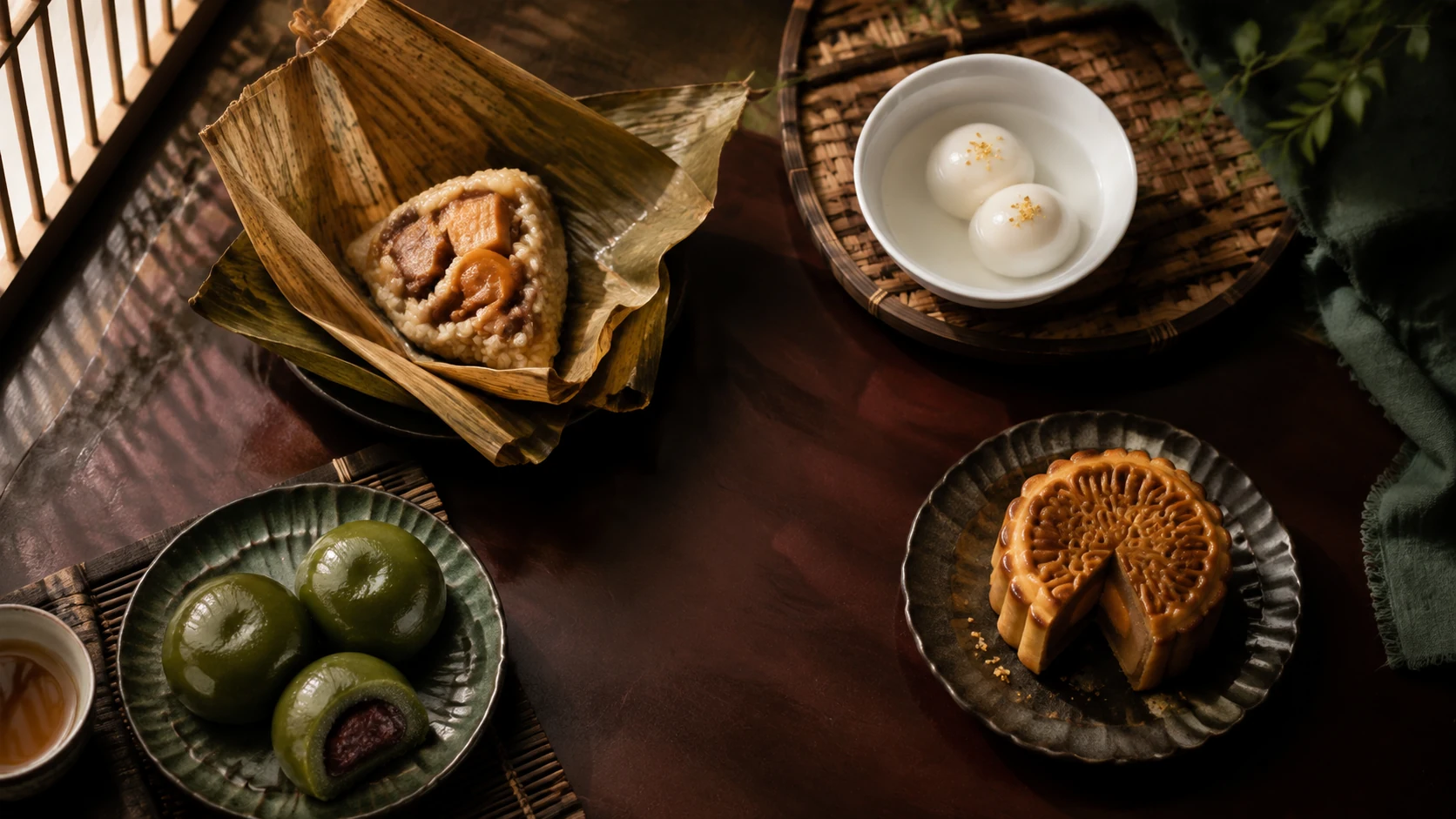
According to the official website, Wufangzhai positions itself as a Chinese seasonal food brand centered on glutinous rice foods, with zongzi as the leading product, extending to mooncakes, tangyuan, pastries, egg products, and other rice products. The brand story shows its history traces back to 1921.
The website organizes entries by Spring Festival, Dragon Boat Festival, Mid-Autumn Festival, Qingming, and daily products, presenting a direction that covers multiple traditional festivals and daily dining scenarios. This structure leads the brand from a single seasonal category to a richer portfolio of seasonal foods, with daily products serving to supplement everyday consumption.
Zongzi remains the revenue anchor; everyday demand needs its own test
2025 main-business revenue by product; RMB million
The revenue mix shows the importance of seasonal products. Everyday expansion requires separate evidence on off-season buying frequency and inventory turnover.
- [1] Wufangzhai 2025 Annual Report ↗Pages 18 and 24: main-business revenue by product; page 31: seasonality · 2026-04-22 · Accessed
02 Facts & context
Key Practices
Official materials show that Wufangzhai splits products by festival at the product level, with the daily section displaying ready-to-eat or convenient rice products such as wet snacks, rice balls, and cup porridge, corresponding to different consumption times. On the channel side, the official website mentions coverage of trading, chain stores, and e-commerce, indicating a multi-channel sales approach.
On the production side, the brand story mentions the launch of the Digital Industry Smart Park and the vacuum zongzi digital-intelligent integrated process demonstration workshop in 2023, reflecting investment in automation and digitalization capabilities for the core zongzi category. These practices provide a foundation for product extension and channel expansion, making the connection between brand renewal and production capacity more concrete.
03 GSP analysis
Can Zongzi Trust Transfer to Mooncakes and Tangyuan: A Mechanism Analysis of Category Relatedness
From its public positioning, Wufangzhai treats zongzi as its leading product and extends to seasonal foods such as mooncakes and tangyuan. The implicit assumption of this strategy is that consumers' trust in the quality of zongzi can be transferred to other glutinous rice or seasonal categories. This transfer does not happen automatically in the food sector. Zongzi and mooncakes differ significantly in raw materials, processes, and consumption scenarios. Zongzi is a staple-like snack that can be savory or sweet, while mooncakes are high-sugar, high-fat gifts.
If consumers trust Wufangzhai because of zongzi, they may be willing to try mooncakes, but whether this trial converts into repeat purchases depends on the mooncake's taste, packaging, and value for money. In contrast, tangyuan has a stronger process connection with zongzi, as both use glutinous rice flour or glutinous rice as the main ingredient and both have a home-cooking attribute, so cognitive transfer may be smoother. However, the tangyuan market already has strong brands such as Sanquan and Synear, so Wufangzhai faces fierce competition upon entry. Therefore, the success of category extension depends not on brand awareness but on establishing an independent quality reputation in each new category. The analysis infers that Wufangzhai needs to formulate differentiated product strategies for different seasonal categories rather than simply replicating the zongzi experience.
For companies seeking to test whether trust in a core product can transfer to adjacent categories, they can first analyze whether the consumer decision-making paths for the two categories are similar. Taking zongzi and tangyuan as examples, they can separately survey when customers buy, whether they plan to give gifts, how they compare specifications, and where they replenish, and then examine the actual decision differences between the two products, rather than presupposing purchase rhythms based solely on category names. If a company directly applies its marketing experience from zongzi gift boxes to tangyuan, it may overlook the latter's shelf competition in supermarket freezers. Therefore, companies should design independent trial strategies for new categories, such as including a tangyuan coupon in zongzi packaging and observing whether the redemption rate is higher than the conversion rate of ordinary advertising, to measure existing customers' acceptance of the new category.
Failures in category extension often stem from companies mistaking brand awareness for category capability. Suppose a zongzi company launches mooncakes. If customers buy mooncakes for the first time due to trust in zongzi, but the mooncake taste is clearly inferior to professional brands, negative reviews may backfire on the zongzi reputation. To distinguish such alternative causes, companies can use a different sub-brand on mooncake packaging and ask about purchase motivation in after-sales surveys. If most customers say they tried it because of the main brand, that can be a clue for brand association, and then observe whether actual experience supports subsequent purchases; if they answer "want to try a new flavor," the product itself is attractive. Companies should set a threshold: new categories should be validated in pilots that match their purchase tasks, measuring acceptance, repeat purchases, and business contribution. Expansion conditions should be explained with samples and costs, not by applying unsupported uniform recommended ratios.
04 GSP analysis
How Daily Products Balance Seasonal Fluctuations: Conflicts in Scenarios and Operations
Wufangzhai's official website has a daily sales product section displaying ready-to-eat rice products such as wet snacks, rice balls, and cup porridge, which can serve as a clue to observe how the company connects with daily consumption, but it cannot confirm its internal goals or that it has alleviated seasonal fluctuations. However, daily products and seasonal products have significant operational conflicts. Seasonal products are typically stocked months in advance, sold intensively in the weeks before the festival, with marketing rhythms centered around the festival; daily products require continuous replenishment, fast turnover, and marketing that relies more on everyday promotions and channel distribution. If the same sales team manages both types of products, they may face divided attention and resource competition.
For example, before the Dragon Boat Festival, the team may be fully engaged in distributing zongzi gift boxes, leaving no time for the terminal display of daily products. In addition, the consumption scenarios for daily products are breakfast, convenience store ready-to-eat, or quick home meals, which are completely different from the gifting scenario of zongzi gift boxes, requiring different packaging specifications, pricing, and channel choices. The website mentions coverage of trade, chain stores, and e-commerce, but does not specify how different channels allocate daily and seasonal products. The analysis suggests that Wufangzhai needs to establish an independent operational rhythm for daily products, or at least set up a dedicated team; otherwise, daily products may become a conceptual supplement and fail to truly smooth seasonal fluctuations.
Plan seasonal and everyday products around different buying rhythms
Proposed occasion-planning framework for a traditional food brand
| Occasion | Demand rhythm | What to test |
|---|---|---|
| Dragon Boat gifting | Concentrated decisions and delivery dates | Preorder fulfillment, aging inventory, and returns |
| Mid-Autumn gifting | Gift-box selection fitted to the recipient | Clear specifications, reliable delivery, and post-holiday stock |
| Everyday meals | Immediate convenience and recurring replenishment | Ease of use, contribution per order, and time between purchases |
Shared brand memory can ease recognition but cannot replace occasion-specific products and replenishment. Observe seasonal sales separately from everyday repeat buying.
- [1] Wufangzhai 2025 Annual Report ↗Pages 18 and 24: main-business revenue by product; page 31: seasonality · 2026-04-22 · Accessed
05 GSP analysis
Matching Digitalized Workshops with Seasonal Supply: The Contradiction Between Capacity Rigidity and Demand Elasticity
The brand story mentions the launch of the 2023 Digital Industry Smart Park and the digital-intelligent integrated production demonstration workshop for vacuum zongzi, showing that Wufangzhai has invested in automation for zongzi production. Zongzi demand is highly concentrated around the Dragon Boat Festival, with the peak season possibly lasting only a few weeks, while off-season demand is very low. Automated workshops typically have high fixed costs and low variable costs, meaning capacity utilization has a huge impact on unit costs. If peak season capacity is insufficient, automation can help with rapid production; but if off-season capacity is idle, depreciation and maintenance costs will drag on profits.
Digital-intelligent processes may bring more stable quality and faster production speed, but they cannot create demand. Therefore, production investments must match sales forecasting and channel capabilities. The analysis infers that Wufangzhai may use digital-intelligent systems to optimize production scheduling and inventory management, but public information does not provide specific data. A testable mechanism is: if the digital-intelligent workshop can shorten changeover times, the company can more flexibly produce zongzi of different specifications or extend to other glutinous rice products, thereby improving annual equipment utilization. Otherwise, the investment may only generate value in the peak season and become a burden in the off-season.
For food companies considering investing in digital-intelligent workshops, they should first assess their product line's changeover frequency and the capacity difference between peak and off-seasons. Suppose a company produces both zongzi and tangyuan, both relying on glutinous rice but with different processes; they should verify whether the equipment, processes, and cleaning arrangements for the two products are compatible, and then use actual changeover and qualified output records to determine whether capacity can be used in staggered shifts. However, automated production lines usually require large batches of continuous production; if each batch order is below the economic minimum order quantity, unit costs may rise instead. Therefore, companies should first use existing manual or semi-automated lines to test the order structure of small batches and multiple varieties, recording changeover times and loss rates, before deciding whether to invest in fully automated equipment. The key to investment decisions is not the technological advancement of the equipment itself, but whether it can match the company's actual order fluctuations.
The value of digital-intelligent systems lies in providing real-time data for scheduling and inventory, but in the early stages of system implementation, data may be distorted due to incomplete data entry or unfamiliarity of employees. Companies can first pilot in one workshop, connecting equipment runtime, fault downtime, and raw material consumption data to the system, and track for three complete production weeks, comparing system records with manual ledgers. If discrepancies arise between system and manual records, they should trace the specific links, distinguishing explanations such as measurement standards, equipment calibration, data entry, and process execution; expanding the system scope at this point would only amplify errors. Another testable mechanism is whether the system can automatically generate off-season maintenance plans to keep equipment in optimal condition before the peak season. If companies only run at full capacity during the peak season and leave equipment idle in the off-season, the return on digital-intelligent investment is limited to improved yield in the peak season, which is unlikely to cover annual depreciation.
06 GSP analysis
Inventory and Channel Synergy Across Multiple Seasonal Product Lines: An Underestimated Complexity
Wufangzhai's official website organizes products by festivals such as Spring Festival, Dragon Boat Festival, Mid-Autumn Festival, and Qingming, meaning the company needs to manage stocking and sales rhythms for multiple festivals simultaneously. Each festival has a short sales window and high demand volatility; for example, Mid-Autumn mooncake sales are concentrated in the month before the festival. If the company operates four seasonal product lines simultaneously, almost every month of the year involves stocking or selling for some festival, requiring extremely high supply chain flexibility. On the channel side, synergy among trading, chain stores, and e-commerce is also critical.
E-commerce channels are suitable for pre-sales and hit products, but logistics costs are high; chain stores are suitable for experience and immediate purchase, but distribution coverage is limited; trading channels may cover wholesale and group purchases, but profit margins are lower. Multiple seasonal products mean channels need to frequently switch promoted products, which may lead to waste of end-of-aisle displays and promotional resources. The analysis suggests that Wufangzhai needs to establish a data-driven demand forecasting system that integrates historical sales, festival calendars, and channel feedback to avoid inventory buildup or stockouts. However, public information does not mention any forecasting or synergy mechanisms, so these are inferences based on the case structure.
For companies operating multiple seasonal product lines, a first step is to draw a festival calendar, marking the stocking start, sales peak, and clearance end for each category, and then arrange cash flow and warehousing accordingly. Taking zongzi and mooncakes as an example, the sales windows for Dragon Boat Festival and Mid-Autumn Festival are about three months apart; if they share the same cold chain or ambient warehouse, they can use storage space at staggered times, reducing idle capacity. But staggering also means the same channel must quickly switch promoted products within a short period, requiring rapid changes in end-of-aisle displays and promotional materials, which demands clear instruction transmission and acceptance standards between headquarters and stores. A feasible practice is to set up an independent SKU owner for each festival, responsible for coordinating production plans, channel distribution, and return/exchange rules, to avoid multiple seasonal products competing for resources within the channel.
The failure condition for multi-seasonal synergy often appears in forecasting: if a company stocks based only on last year's sales during the same period, ignoring demand changes from new channels or competitor promotions this year, it may face stockouts of hit products before the festival or large returns after the festival. To distinguish alternative causes, companies can record pre-sale orders, store replenishment frequency, and e-commerce search indices for each seasonal product, and compare the sources of deviation between actual sales and forecasts in post-festival reviews. If stockouts are concentrated in one channel, it may be a distribution strategy issue; if all channels are below expectations, it may be a product taste or pricing issue. Companies should treat the festival calendar as a rolling planning tool, updating the stocking volume for the next six months monthly, rather than fixing annual production at the beginning of the year.
07 GSP analysis
Organizational Prerequisites for Time-Honored Brand Renewal: How Product Managers and Channel Data Determine Portfolio Success
The Wufangzhai case appears to be a product portfolio issue on the surface, but at a deeper level, it is an organizational capability issue. From public information, the company splits products by festival and daily, which requires corresponding product managers or brand managers to plan each festival line. Each festival line needs independent market insights, product development, and promotional plans, yet must share brand assets and channel resources. If the organizational structure remains functional, for example, with a unified sales team responsible for all products, then festival products and daily products may compete for the same salespeople's energy. The allocation of decision rights and responsibilities is key: who decides the stocking volume for each festival?
Who is responsible for inventory turnover? If product managers do not have profit responsibility, they may tend to expand product lines while ignoring costs. Channel data is another key factor. E-commerce platforms provide real-time sales data, while offline store data feedback may lag. If a company cannot integrate multi-channel data, it is difficult to determine which category truly contributes profit. The analysis infers that Wufangzhai needs to establish cross-functional festival product teams with clear P&L responsibility, and invest in channel data integration systems, to make the multi-seasonal portfolio strategy work.
08 Suggested actions
How Reader Companies Can Pilot Seasonal Extensions: Verification Steps from Core Product to Adjacent Categories
For traditional food companies like Wufangzhai, if they want to replicate its seasonal extension strategy, it is recommended to conduct small-scale pilots first. The first step is to select an adjacent category with the strongest process or raw material connection to the core product. For example, a zongzi company could try tangyuan because both rely on glutinous rice processing. The second step is to launch test products in a limited region or on a single e-commerce channel, avoiding the waste of resources from a full-scale rollout. The third step is to set clear success metrics such as repurchase rate, trial conversion rate, and channel sell-through rate, rather than focusing only on initial sales volume. During the pilot, special attention should be paid to whether consumers try the new product because of the core brand and whether they repurchase because of the product itself.
This can be observed by comparing the purchase behavior of new and existing customers. For example, differences in repurchase rates between existing and new customers can provide clues, but factors such as purchase habits, discounts received, and channel accessibility must also be considered. Similarity between the two alone cannot prove product appeal; it should be understood in conjunction with trials, actual experience, and subsequent purchases. Additionally, it is recommended to collect channel feedback during the pilot, especially data on terminal display and promotional response, to determine whether the product fits the channel. The pilot period should cover at least one complete seasonal cycle to observe demand fluctuations. If the pilot succeeds, expansion to other seasonal categories can be gradual.
When piloting seasonal extensions, companies can first select an adjacent category that shares raw materials or processes with the core product. For example, a company with glutinous rice pastries as its core could trial rice cakes or qingtuan, but they should verify process, equipment, and personnel requirements based on actual recipes and production flows, not assume that equipment can be reused simply because both use glutinous rice. The pilot region should preferably be a city with medium brand penetration but convenient logistics, avoiding the headquarters location, because local consumers may give inflated feedback due to brand loyalty. Test products should use independent packaging and sub-brand identification to distinguish in surveys whether customers ordered because of the main brand or the new product itself. If repurchase for the new product is weaker than expected, first compare similar purchase cycles and usage tasks, distinguishing reasons such as taste, specifications, channel, and repurchase opportunities, before deciding to adjust the product or communication.
During the pilot, a simple experiment should also be designed to distinguish brand transfer from product appeal: set two versions on the e-commerce product page, one emphasizing the heritage of the time-honored brand and the other highlighting the new product's taste or convenience, randomly assign visitors, and compare add-to-cart rates. If the version emphasizing heritage performs better, verify the clarity of the copy, discounts, and audience comparability before judging the role of brand association; no difference between the two does not prove the new product can stand alone. At the same time, companies should record the subsequent full-size purchase behavior corresponding to each trial coupon code to determine whether trials truly drive repurchase. After the pilot ends, if expansion is decided, it should first enter regions similar to the pilot channel characteristics rather than immediately rolling out nationwide, because regional taste differences for seasonal products may be greater than expected.
09 Suggested actions
When to Shrink or Adjust Extensions: Business Decisions Based on Data Signals
Not all seasonal extensions are worth persisting with. Companies should establish a clear adjustment mechanism based on data signals rather than intuition. First, if a new category's repurchase rate among existing customers falls below the preset threshold after the pilot period, and the cost of acquiring new customers is higher than that of the core category, then consider reducing investment in that category. Second, if daily products fail to contribute significant revenue for two consecutive quarters, and channel feedback shows they are crowding out the display resources of seasonal products, then reassess the daily product strategy.
Another adjustment signal is inventory turnover: if a seasonal product shows longer inventory dwell time and increased discount dependence compared to its comparable seasonal products, first check factors such as stocking, channels, pricing, and taste before deciding whether to adjust the category positioning. At the organizational level, if product managers cannot access channel data or lack decision-making authority, leading to high trial-and-error costs, then the company should first adjust the organizational structure rather than blindly expanding the product line. It is suggested to observe, not from actual company testing, whether the natural sales share of the new category without promotions continues to rise. In summary, the boundary of extension strategy lies in the transferability of brand trust and the match of operational capabilities. Companies should regularly review whether these conditions hold.
THE EVIDENCE
Grounding the argument in evidence.
What the source reports
The official website shows Wufangzhai positions itself as a Chinese seasonal food brand centered on glutinous rice foods, with zongzi as the leading product, extending to mooncakes, tangyuan, pastries, egg products, and other rice products; the site organizes entries by Spring Festival, Dragon Boat Festival, Mid-Autumn Festival, Qingming, and daily products; channels cover trading, chain stores, and e-commerce.
This structure indicates the company is proactively expanding the brand from a single Dragon Boat Festival symbol to a portfolio of multiple seasonal and daily scenarios, but public information does not provide sales shares or channel performance for each category, making it impossible to verify the actual contribution of the portfolio.
What the source reports
The brand story mentions history traceable to 1921, and mentions the launch of the Digital Industry Smart Park and the vacuum zongzi digital-intelligent integrated process demonstration workshop in 2023.
Historical heritage provides a brand trust foundation, while production digitalization investment shows the company is attempting to use automation to address supply fluctuations for seasonal products like zongzi, but public information does not disclose capacity utilization or cost changes.
DECISION POINTS
From understanding to testable action.
When selecting pilot categories, prioritize craft relatedness over market heat
Before extending, list the core product's raw materials, processes, and consumption scenarios, and select the adjacent category with the highest relatedness for small-scale testing.
Suggested observation, not company-measured: whether the trial-to-purchase conversion rate of existing customers for the pilot category is significantly higher than that of new customers.
Establish an independent operational rhythm for daily products to avoid resource contention with seasonal products
Set up a separate sales team or at least an independent promotional calendar for daily products to ensure they are not overshadowed by seasonal campaigns.
Suggested observation, not company-measured: whether the channel distribution rate for daily products remains stable during non-festival months.
Regularly assess the annual utilization rate of digital-intelligent equipment, not just peak-season capacity
Before investing in automation, simulate off-season capacity utilization scenarios and design multi-category co-production plans.
Suggested observation, not company-measured: compare actual feedback and delivery records before and after the action to confirm whether changes stem from this action, and consider whether other explanations are equally plausible.
QUESTIONS TO EXPLORE
What still needs to be established?
- Public information does not disclose the specific sales shares and profit contributions of Wufangzhai's various seasonal categories, making it impossible to determine whether product lines beyond zongzi are truly profitable.
- The actual capacity utilization and cost structure of the digital-intelligent workshop are not public, making it impossible to assess its return on investment period.
CONTINUE THE RESEARCH
Explore your question further.
Request the full research report and discuss your market, brand questions and business context with GSP.
Request the full research report ↗