
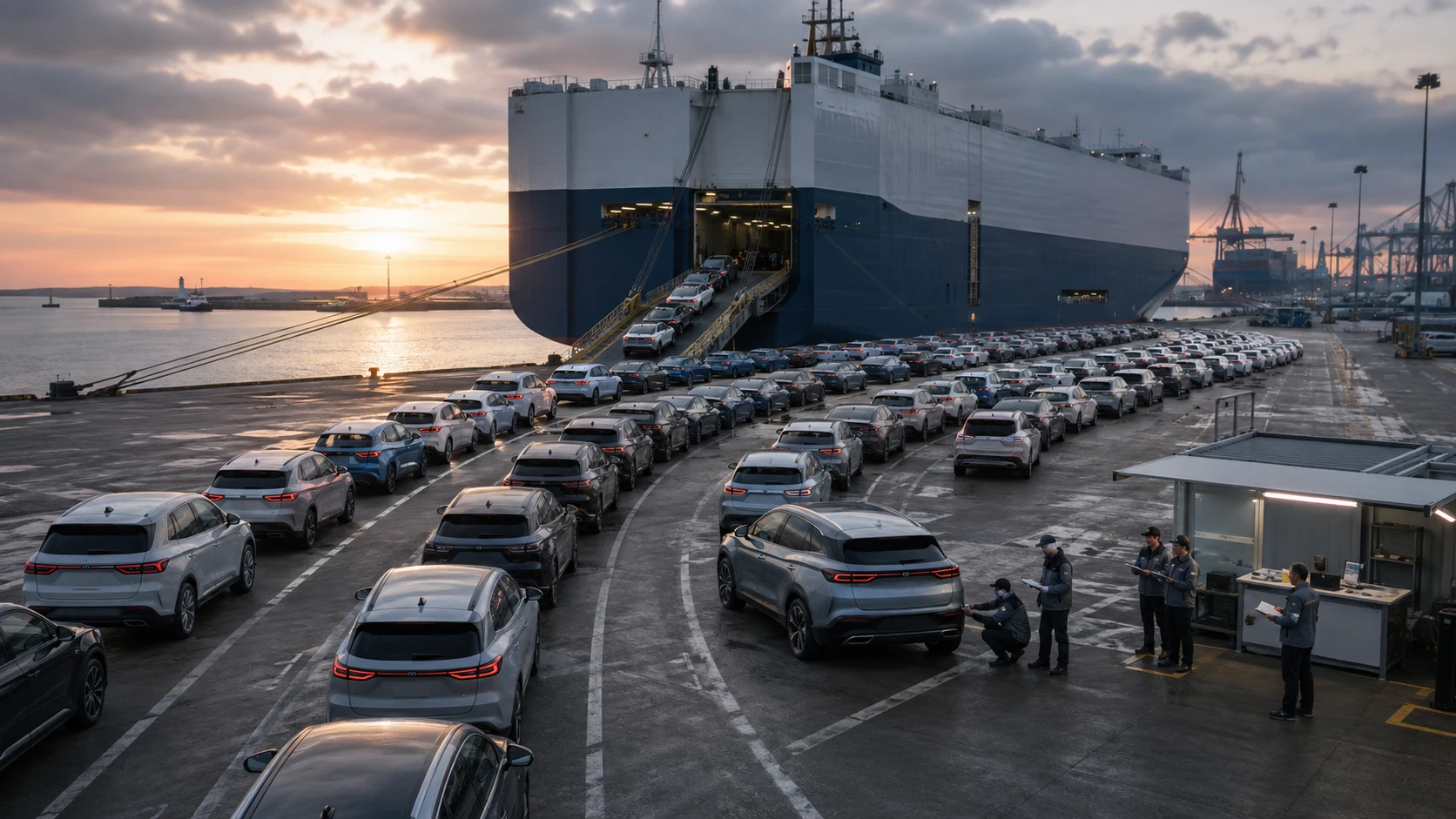
01 Facts & context
Brand Positioning
In the investor Q&A on SAIC Motor's official website, the company proposed a brand portfolio direction that coordinates premium, mainstream, and global markets, and aims to enhance MG's influence in the global market. MG's official website highlights high value and globalization as development directions, introducing its electric transformation and reliance on the group's system capabilities.
These materials are suitable for studying group brand division: the group organizes common capabilities such as technology and manufacturing, and each brand needs to explain its unique value to target users. This article takes SAIC Motor's brand portfolio as the research subject and uses MG as a specific observation point for overseas operations.
A global brand portfolio needs distinct platform and local roles
Company disclosures for 2025; share, overseas total, and regional brand subset are not additive
- Own-brand sales share [1]
- 65%Own-brand volume as a share of group vehicle sales
- Exports and overseas sales [1]
- 1.071million vehiclesIncludes exports and overseas-market sales, not exports alone
- MG Europe sales [1]
- >300,000vehiclesRegional brand sales within the overseas business
Overseas scale makes cross-market coordination necessary. Local brand effectiveness still depends on local product choice, channel delivery, and customer feedback.
- [1] SAIC Motor releases its 2025 annual results ↗Paragraphs on own-brand share, exports and overseas-market sales, and MG Europe · 2026-04-01 · Accessed
02 Facts & context
Key Practices
In public strategies, SAIC has proposed advancing localization through overseas R&D centers, production bases, and service systems, emphasizing synergy among products, supply chains, and brands. The MG brand introduction links overseas market development with electric products.
These statements indicate that the company's planned overseas operations cover multiple aspects beyond products. The implementation of these directions requires translating group arrangements into clear execution rhythms for each market. For specific market research, it is also necessary to examine local models, sales networks, service conditions, and user feedback to confirm how group capabilities translate into locally available experiences.
03 GSP analysis
Causal Mechanism of Brand Division: From Group Capabilities to User Choice
Inferring from public practices, SAIC Motor's multi-brand strategy implies a causal chain: the group accumulates technology, manufacturing, and supply chain capabilities, but these capabilities cannot directly reach users; they must be translated by brands into user-perceivable value. For example, the MG brand emphasizes high value and globalization, which requires product design, pricing, marketing, and service to support it. If brand positioning is unclear, users may perceive MG as an ordinary Chinese brand, making it difficult to establish a premium image.
Therefore, the essence of brand division is to make each brand clearly answer: 'Who do we serve, what problems do we solve, and why are we better than competitors?' Group capabilities provide the foundation, but brands must create differentiation. This mechanism is particularly important in overseas markets, where local users have low awareness of Chinese brands, and brand value requires more proactive communication.
For companies seeking to replicate SAIC's multi-brand synergy, they must first identify which group capabilities truly influence user choices. Taking MG in overseas markets as an example, the group may possess electric vehicle platforms and supply chain cost advantages, but these advantages only translate into user willingness to pay a premium when they become convenient charging, reliable range, or quick repairs. Suppose a company operates both premium and mainstream brands. If they share platforms but do not differentiate performance tuning or service standards, users will question brand differences due to similar experiences. Therefore, the causal mechanism of brand division requires group capabilities to be configured in layers according to brand promises: basic safety and quality can be shared, but details that affect perception, such as suspension tuning, infotainment interfaces, or after-sales response, must be independently set. In execution, companies should map the value from group capabilities to user touchpoints, noting where each capability is perceived by users, and decide which capabilities must be managed by brand-specific teams and which can be provided uniformly by the group. Without such decomposition, brand division may remain a slogan, and users cannot identify differences in products and services.
04 GSP analysis
Fulfilling Localization Commitments: The Closed Loop of Service Networks and User Feedback
SAIC Motor proposes that localization includes R&D, production, and services, but what users truly experience is the entire process of purchase and use. Suppose a European user buys an MG electric vehicle; they care about charging convenience, repair waiting times, and software updates. If the group only invests in product R&D and neglects service networks, user satisfaction will decline.
Therefore, localization requires advancing service network construction in parallel with product sales. Specifically, the group needs to establish spare parts warehouses, train local technicians, set up customer service hotlines, and collect user feedback to improve products. The difficulty of this closed loop lies in feedback speed: if local teams discover problems and must report to headquarters through multiple levels, the decision cycle may be too long, and user issues may worsen. Therefore, it is necessary to clarify the decision-making authority of local teams, for example, authorizing them to handle small claims or emergency spare parts allocation.
When companies advance localization commitments, they should first verify the match between service networks and user expectations. Suppose MG sells electric vehicles in a European country, and users expect maintenance waiting times not to exceed three days, but local service points only cover major cities, and users in remote areas may wait a week. If the group only focuses on sales growth and ignores service radius, user satisfaction will decline, and brand reputation will suffer. A specific practice is: before launching in a new market, draw a service map, marking the distance and towing time from each sales area to the nearest service point, and set an acceptable maximum waiting time. If it exceeds the standard, mobile service vehicles or partnerships with third-party repair shops should be arranged in advance. At the same time, companies should establish a spare parts inventory forecasting model, calculating spare parts demand for each region based on historical sales and failure rates, to avoid delays due to parts shortages. In execution, local teams need the authority to allocate emergency spare parts, such as transferring from neighboring countries or using expedited logistics, without having to request headquarters each time. This authorization can significantly shorten user waiting times, but budget caps and approval processes must be set to prevent abuse. Companies should also regularly compare maintenance waiting times and user satisfaction across regions to identify service shortcomings and adjust resource allocation.
Shared capabilities and local choices need clear decision ownership
Proposed global-local collaboration framework for a multi-brand automaker
| Collaboration level | Appropriate role | Validation to retain |
|---|---|---|
| Group platform | Coordinate technology, delivery capabilities, and common standards | Whether shared capabilities fit the product and market |
| Brand role | Define reasons to choose and portfolio boundaries | Whether each brand offers a distinct purchase value |
| Local market | Adapt channels, language, service, and usage occasions | Whether local customers understand and receive the promise |
A common platform does not require identical communication. Specify shared capabilities, brand-owned promises, and choices requiring local validation.
- [1] SAIC Motor releases its 2025 annual results ↗Paragraphs on own-brand share, exports and overseas-market sales, and MG Europe · 2026-04-01 · Accessed
05 GSP analysis
Comparison with Single-Brand Strategy: The Trade-off Between Synergy and Duplication
Compared to exporting under a single brand, SAIC's multi-brand strategy may generate synergies, but it also increases management complexity. Sharing R&D platforms and supply chains may reduce duplicate investment, but whether it lowers per-vehicle costs must be assessed based on actual utilization, product differentiation requirements, and coordination expenses; however, multi-brand requires each brand to have an independent marketing team and budget, which may lead to resource dispersion.
For example, if premium and mainstream brands share a platform but have different interiors, exteriors, and configurations, development costs can be saved; but if the target markets of the two brands overlap, they may compete with each other. For benchmarking companies, brand division should be based on the specific customer groups and purchase reasons in each market, rather than permanently equating a brand with a single price or capability label; MG's public global expression provides an observation entry point, but it is not sufficient to prove that the group has internally allocated tasks according to this simplified approach. Such a division requires a strong coordination mechanism at the group level, otherwise brands may compete for resources.
If a benchmarking company adopts a multi-brand export strategy, it must first calculate the marginal cost between shared platforms and independent marketing. Suppose a benchmarking group allows its different brands to share platforms but develop their own interiors and exteriors; before making decisions, it should verify which development efforts are truly reduced and which adaptation and testing costs are added. However, if two brands set up independent showrooms in the same European country, rent and personnel expenses will offset some savings. Management should require each brand to submit a market overlap assessment, such as target customer age, price range, and repurchase sources, to determine whether brands are competing for the same transactions or whether they can increase total coverage through clear division of labor, rather than adopting unverified uniform proportional thresholds. In execution, group procurement can negotiate batteries and chips uniformly, but brand departments must retain decision-making power over interiors and exteriors, otherwise synergy may turn into homogenization.
Failures in multi-brand synergy often stem from conflicting performance indicators. Suppose one brand of a benchmarking group focuses on profit margin, while another focuses on sales volume share; when sharing a factory, production scheduling priorities may cause internal friction. Benchmarking companies can establish a cross-brand product committee, led by the group's planning department, to review each brand's product roadmap monthly, clarifying which technology modules must be shared and which experience differences are allowed independent investment. For example, smart cockpit software can share the underlying layer, but interface style and voice assistant personality are defined by the brand. If a brand requests exclusive access to a new technology, it must explain the uniqueness of that technology's user value and bear higher development allocation. This preserves synergy while preventing brand boundary blurring.
06 GSP analysis
Specific Transaction Scenarios: Value Delivery from Showroom Experience to After-Sales Service
Taking MG's sales in overseas markets as an example, the first scenario where users contact the brand is the showroom. Sales personnel need to explain the electric vehicle's range, charging, and smart features. This information comes from the group's technical materials but needs localized expression. If the showroom experience is poor, users may switch to other brands. After the transaction, users go through delivery, registration, and insurance, which require collaboration between local teams and dealers.
During use, users need charging station information, software updates, and maintenance reminders. Suppose a user encounters a charging fault; they may contact customer service, which needs to determine whether it is a vehicle issue or a charging station issue and arrange repairs. In this process, each step relies on tools and training provided by the group. If the group only provides products and ignores these scenarios, user value will be diminished.
The value delivery of the showroom experience relies on localized sales tools. Companies can develop digital configurators that allow users to select battery capacity, color, and interior, and display prices and subsidies in real time. But local sales personnel need to master charging cost calculations, for example, combining local electricity prices and average commuting distances to explain monthly usage costs. If the group provides unified training but does not consider language differences, sales explanations may be stiff. Therefore, multi-language scenario scripts should be created, and local teams should participate in revisions. Suppose users in a certain market care more about second-hand residual value; sales personnel need to be able to show battery warranty terms and repurchase plans, which require coordination with the finance department; otherwise, promises cannot be fulfilled.
After-sales service must clarify responsibility boundaries. Suppose a user has a charging fault; customer service must first conduct remote diagnostics of the vehicle status. If it cannot be resolved, dispatch to a partner charging network or repair station. Companies should establish a service process matrix, distinguishing vehicle faults, charging station faults, and user operation issues, and specify response times. For example, vehicle faults are handled by the brand service center, charging station issues by energy partners, but customer service must receive and track all cases. If the group only provides products and ignores these scenarios, users will complain about long waits. Therefore, a service experience officer role can be established to regularly simulate faults and evaluate the connection of each step, ensuring that each touchpoint has a clear responsible person.
07 GSP analysis
Cost and Economic Trade-offs: Balancing Unit Economics and Long-term Investment
Overseas operations require substantial upfront investment, including building factories, establishing networks, and brand promotion. The group needs to assess the unit economics of each market, that is, revenue per vehicle minus cost per vehicle (including manufacturing cost, logistics, tariffs, marketing, and service allocation). The formula in words is: marginal contribution per vehicle = selling price per vehicle - variable cost per vehicle (manufacturing + logistics + tariffs + sales commissions). Fixed costs such as R&D and factories need to be allocated based on sales volume, so when initial sales are low, unit costs are high.
The group may choose to test the waters through imports first, then decide whether to localize production. This trade-off requires comparing the cost structures of different options. For example, whether localization reduces tariff and logistics expenses depends on the applicable conditions of the target market, component sources, manufacturing plans, and actual transportation arrangements, but it requires investment in factories and adaptation to the local supply chain. If the market size is small, importing may be more economical. Therefore, decision-makers need to choose the entry mode based on market potential, competitive landscape, and their own resources.
08 Suggested actions
Organizational Responsibilities and Work Interfaces: Who Decides Product and Service Adaptation
At the group level, R&D centers are responsible for product platforms, brand companies for market positioning, and overseas subsidiaries for local operations. But whether products need adjustments, such as adding cold weather packages or modifying charging interfaces, requires overseas subsidiaries to raise requirements, R&D centers to assess feasibility, and brand companies to confirm whether it affects brand image. In this process, decision-making power may be concentrated at headquarters, leading to slow responses.
It is recommended to establish a cross-departmental committee to regularly review overseas requirements and authorize overseas subsidiaries to make decisions on non-core changes. At the same time, a data sharing platform should be established to let headquarters understand local sales, user feedback, and service quality. In terms of responsibility allocation, brand companies are responsible for sales volume and brand health, overseas subsidiaries for local operational indicators, and the group for overall investment return.
When companies establish a cross-departmental committee, they should clarify its decision boundaries and escalation mechanisms. Suppose the group has multiple overseas markets, each with different needs for product changes, such as battery preheating in cold regions and enhanced cooling in tropical regions. If the committee requires all changes to be approved by headquarters, the response cycle may take months, causing local teams to miss market opportunities. A feasible approach is to set change levels: non-functional changes such as exterior colors and interior materials are authorized to brand companies; changes involving battery management or chassis structure require R&D center assessment; and changes affecting core brand promises require full committee approval. Each level of decision must have a specified time limit, for example, brand companies respond within five days, and R&D centers provide feasibility reports within two weeks. At the same time, the committee should regularly review decision results, comparing the market effects of authorized changes versus headquarters-approved changes, to adjust authority allocation. If local teams frequently request non-core changes, it indicates that the authorization scope is too narrow; if authorized changes cause quality issues, standards need to be tightened. This dynamic adjustment relies on a data sharing platform that updates sales, complaints, and change requests in real time, enabling the committee to make decisions based on facts rather than impressions.
In responsibility allocation, companies need to avoid conflicts among multiple indicators. Suppose brand companies are responsible for sales volume, overseas subsidiaries for local profits, and the group for overall investment return. The three may have friction due to inconsistent goals. For example, brand companies may request price reductions to boost sales, but subsidiaries may oppose it to protect profits; the group may want rapid expansion, but subsidiaries worry about service lagging. To resolve conflicts, companies can set joint responsibility indicators: brand companies and subsidiaries jointly bear market share and customer satisfaction, while the group assesses long-term brand equity. Specifically, each market can set a 'brand health' index, including awareness, recommendation willingness, and complaint rates, jointly responsible by brand companies and subsidiaries. When product change needs arise, both parties must jointly submit an impact assessment, explaining expected impacts on sales, costs, and brand image. If opinions diverge, the committee can introduce third-party data, such as user surveys or competitor comparisons, as a basis for adjudication. In addition, companies should establish a post-hoc review mechanism for major changes, analyzing whether information was sufficient and assumptions held. If failure stems from missing information, improve data collection; if from judgment errors, adjust the decision process. Through this closed loop, organizational responsibility can truly support brand division rather than remain on paper.
09 Suggested actions
Pilots and Measurement: How to Validate Brand Division and Localization Strategies
It is recommended that companies choose one or two overseas markets for pilots, for example, MG in a European country. During the pilot, key indicators can be measured: brand awareness (through surveys), user satisfaction (through after-sales follow-ups), repeat purchase rate (through sales data), and market share. At the same time, a control group can be set up, for example, in another market without special service investment, to compare differences.
Observation plan: If user feedback speed is faster in the pilot market and product improvements are launched promptly, it indicates that the feedback loop is effective; if brand awareness increases but sales do not, pricing or channels may need adjustment. The pilot period is recommended to be one year to cover a complete product usage cycle. Based on the results, decide whether to expand investment or adjust brand division.
Pilot measurement should distinguish the effects of brand division from localization execution. Suppose a company chooses Spain as the MG pilot, while premium brands enter France, but dealer capabilities differ between the two countries; sales differences may come from channels rather than brand strategy. To separate variables, set up two regions within the same market: one region provides charging installation assistance and door-to-door maintenance according to group standards, while the other provides only basic services, comparing user complaint rates and repurchase intentions after six months. If the service-enhanced region has a repurchase rate ten percentage points higher, it indicates that localization investment is effective; if the difference is small, the problem may lie in product pricing or brand awareness.
During the pilot, it is also necessary to measure the impact of information feedback speed on product improvement. Companies can establish weekly meetings, requiring local service teams to enter user fault descriptions, repair records, and dealer suggestions into a unified system, with group engineers screening high-frequency issues monthly. Suppose it is found that a certain model has slow power response when starting on a slope. If feedback to R&D takes only two weeks, a software update can be pushed quickly; if the process takes three months, users may have already churned. Therefore, the pilot should set feedback loop time limits, such as two-week response for critical issues and one-month evaluation for general issues. At the same time, set up a control market without rapid feedback to observe changes in user satisfaction, proving the value of the closed-loop mechanism.
THE EVIDENCE
Grounding the argument in evidence.
What the source reports
In the investor Q&A on SAIC Motor's official website, the company proposed a brand portfolio direction that coordinates premium, mainstream, and global markets, and aims to enhance MG's influence in the global market.
This indicates that at the group level, there is an intention to cover different market tiers through brand division, but how this is implemented requires each brand to clarify its positioning and resource allocation.
What the source reports
MG's official website highlights high value and globalization as development directions, introducing its electric transformation and reliance on the group's system capabilities.
The MG brand emphasizes reliance on the group system, but users care more about the product itself. Therefore, the brand needs to translate group capabilities into specific product features and service commitments.
DECISION POINTS
From understanding to testable action.
Clarify the mapping between brand positioning and group capabilities
For each brand, draw a capability requirement list, specifying which capabilities must be independent and which can be shared, and designate brand leaders to interface with group departments.
Suggested observation, not company-measured: whether brand teams can clearly explain their target users and differentiated value, and whether group resource allocation aligns with brand priorities.
Establish a feedback loop for overseas service networks
Set up local service teams in pilot markets and authorize them to handle user issues within a certain scope, while establishing a weekly reporting mechanism to headquarters.
Suggested observation, not company-measured: whether the average resolution time for user complaints shortens, and whether product improvement suggestions from service teams are adopted by headquarters.
Design a unit economic model and review it regularly
For each overseas market, create a calculation template for unit contribution margin, and update actual data quarterly to compare profitability across markets.
Suggested observation, not company-measured: which markets have higher-than-expected unit contribution margins, and which cost items exceed budgets, guiding resource adjustments.
QUESTIONS TO EXPLORE
What still needs to be established?
- Existing public materials do not disclose SAIC Motor's specific sales volume, market share, or user satisfaction data for overseas markets, so it is impossible to verify the actual effectiveness of the brand division strategy.
- MG's specific product configurations, pricing strategies, and service network coverage in overseas markets are not public, making it difficult to judge whether its localization depth is sufficient.
CONTINUE THE RESEARCH
Explore your question further.
Request the full research report and discuss your market, brand questions and business context with GSP.
Request the full research report ↗